Recently, the research team led by Professors Xu Qiutao and Zhang Jisen from the School of Agriculture at Guangxi University (GXU) published a review article titled "Stimulus-responsive nuclear moonlighting of plant metabolic enzymes rewires chromatin" in the international journal Trends in Biochemical Sciences (a journal in the field of biochemistry and molecular biology under Cell Press). Xiao Guiyu, a master's student at the School of Agriculture, is the first author; Xu Qiutao and Zhang Jisen are co-corresponding authors; and GXU is the primary affiliation for the paper.
This study systematically summarizes the latest progress in the phenomenon of nuclear translocation of plant metabolic enzymes and innovatively proposes a conceptual framework in which metabolic enzymes connect metabolism and chromatin regulation through three non-mutually exclusive modes, providing important theoretical support for an in-depth understanding of the reciprocal regulatory relationship between plant metabolism and epigenetic modifications.
The study found that signals such as the plant hormone ethylene, light changes, high-temperature stress, and oxidative stress can respectively induce the precise nucleocytoplasmic transport of various core metabolic enzymes, including the pyruvate dehydrogenase complex (PDC), pyruvate kinase (PK), α-ketoglutarate dehydrogenase (KGDH), and glyceraldehyde-3-phosphate dehydrogenase (GAPDH). Building on these findings, the team summarized three functional models for chromatin regulation by metabolic enzymes. The metabolite supply model, in which nuclear enzymes provide key substrates for chromatin modification, such as ACLA2 and PDC generating acetyl-CoA in the nucleus. The enzyme-chromatin modifier interaction model, in which metabolic enzymes directly form functional complexes with histone-modifying enzymes, such as the interaction between KGDH and JmjC demethylases, and the coordinated regulation by MBP-1 and SRT1. The direct chromatin modification regulation model, in which metabolic enzymes themselves evolve into non-canonical histone-modifying enzymes and directly catalyze histone chemical modifications, such as PK1 and PK6-8 directly phosphorylating histone H3T11. These findings indicate that nuclear-localized metabolic enzymes have ascended from passive substrate suppliers to active "moonlighting chromatin regulators."
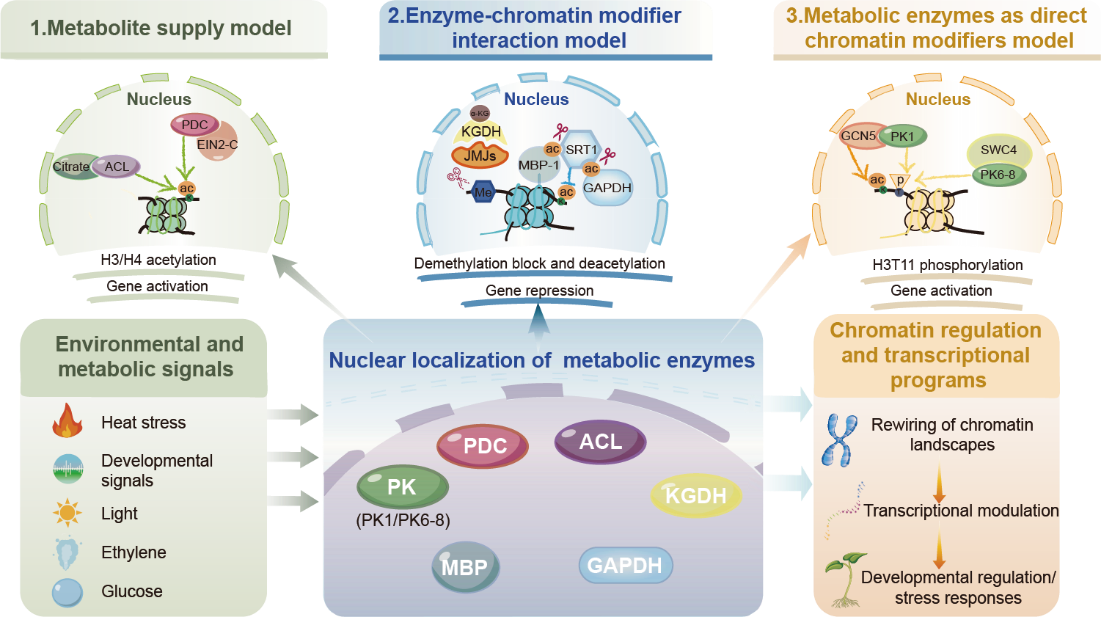
The article further points out that from mammals to plants, the strategy of utilizing metabolic enzymes as nuclear epigenetic regulators is highly conserved in evolution, forming an information bridge that traverses "metabolism-chromatin". Meanwhile, this field still faces multiple challenges, such as the lack of rigorous endogenous validation for the stimulus-responsive nuclear translocation of certain enzymes, the difficulty in precisely distinguishing between direct intranuclear functions and indirect effects of metabolic reprogramming, and the comprehensive spectrum of potential nuclear metabolic enzymes in plants as well as their target gene site-specific regulatory mechanisms, which remain key scientific issues that urgently need to be addressed.
It is reported that this research was funded by the Guangxi Outstanding Youth Science Fund, the Guangxi Science and Technology Major Special Project, and the National Natural Science Foundation of China, among others.

 Address: No.100,East Daxue Road,Xixiangtang District,Nanning, Guangxi,China
 Postal Code: 530004
 Tel: 86-771-3238863
 Email: gjc@gxu.edu.cn